
- Homepage
- Decade
- Material
- Origin
- Americas (10)
- Atrohlau (7)
- Austria (44)
- Austrian (8)
- Bohemia (364)
- Czech (52)
- Czech Republic (10)
- England (28)
- English (49)
- European (10)
- France (54)
- French (61)
- Germany (19)
- Majolica (10)
- North America (19)
- Pennsylvania (7)
- Staffordshire (16)
- United Kingdom (10)
- United States (8)
- Unknown (13)
- ... (4753)
- Pattern
- Shape
- Type
Nouveau Daisy Makeig-Jones Wedgwood Fairyland Lustre green butterfly bowl c. 1920
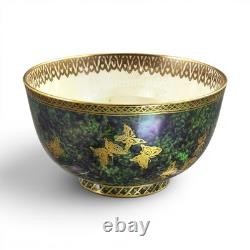
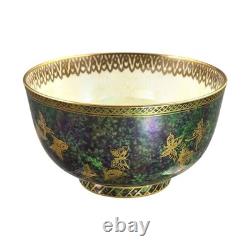
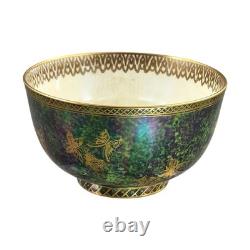

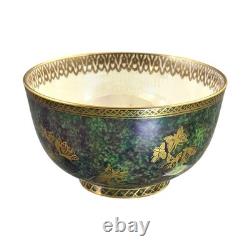
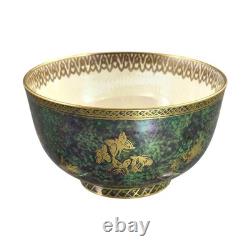
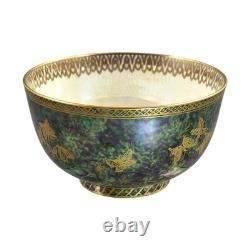
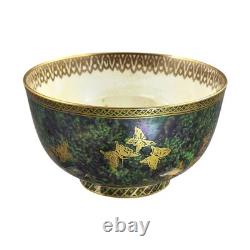
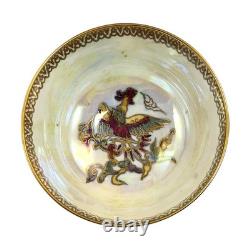
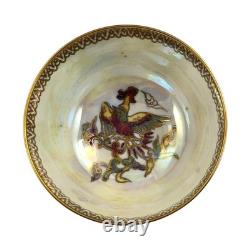


A finely decorated Wedgwood Fairyland Lustre bowl produced in England circa 1920 under the direction of. This cabinet-sized example belongs to the celebrated Fairyland Lustre range, renowned for its iridescent glazes, rich gilding and imaginative decoration.
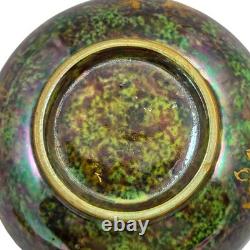
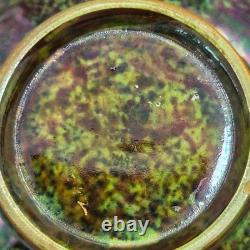
The exterior is finished in an attractive mottled green ground enriched with deep emerald, olive and violet iridescent tones. Delicately gilded butterfly motifs are scattered across the surface, creating a lively contrast against the metallic lustre.
The rim and foot are further enriched with finely gilded Greek Key ornament. The interior is decorated in luminous Mother-of-Pearl Lustre with the characteristic iridescence for which Fairyland Lustre became famous. At the centre is a finely painted exotic bird perched amongst stylised foliage and highlighted with gilded details. The original factory mark and pattern number have largely worn away, with only faint traces remaining. The bowl is presumed to correspond to Wedgwood pattern Z4831; however, some decorative details differ from the catalogue description, and Fairyland Lustre production occasionally shows variation and mixing of recorded pattern elements during manufacture.
Daisy Makeig-Jones played a major role in the success of Wedgwood's lustre wares during the early twentieth century, helping to elevate the factory's reputation through her imaginative Oriental, mythical and fantasy-inspired designs. Today, Fairyland Lustre remains among the most sought-after and widely collected products ever produced by Wedgwood. Bowls of this size were intended as decorative cabinet pieces and are particularly appreciated for the way their surfaces change colour under different lighting conditions. This attractive example combines a rich green exterior, luminous Mother-of-Pearl interior and finely painted bird decoration, characteristic features of one of Wedgwood's most desirable decorative ranges. Height: 6 cm / 2.36? Diameter: 10.4 cm / 4.09?Full preservation of the enamels, colours and gilding. UV examined with no evidence of restoration. Carefully packed using recycled materials where possible. Please study all photographs carefully as they form part of the description and feel free to ask any questions.